
Bridgewater Hospital Discharge Paths
Bridgewater State Hospital is a medium-security forensic hospital, not a conventional state prison. Its core population includes men civilly committed without criminal sentences. It may also receive pretrial detainees for competency or criminal-responsibility evaluation. Those legal statuses create different departure records and different next destinations.
A civil patient may be discharged to the community, transferred to another treatment placement, or remain subject to a new or continued court order. A pretrial detainee may return to the ordering court or originating custodian after evaluation. In that case, the hospital placement ends while the criminal case and custody continue. The event should be called a return or transfer unless the responsible authority confirms an actual community release.
| Hospital departure | Likely next status | Primary proof |
|---|---|---|
| Civil discharge | Community or another treatment plan | Ordering court and hospital record |
| Evaluation completed | Return to court or originating custodian | Court docket and agency movement record |
| Placement transfer | Continued care or secure placement | Court order and receiving-facility record |
| Criminal case release | Depends on bail, dismissal, sentence, or other order | Criminal docket and responsible custodian |
Confirm Bridgewater Hospital Discharge
Start by identifying the court and type of order. Paperwork from the commitment, evaluation, or criminal case may supply a docket number and the name of the originating agency. Remote MassCourts access to most criminal cases requires that docket number. If it is unknown, the correct clerk or a courthouse public terminal may help locate the public case under court access rules.
- Identify whether the placement was a civil commitment, a competency evaluation, or a criminal-responsibility evaluation.
- Find the ordering court and docket. Read the latest public order for continuation, return, transfer, or discharge.
- Contact Bridgewater State Hospital for the proper records or status-routing channel without seeking protected clinical details.
- For a pretrial person, contact the originating jail or court to learn whether criminal custody continued after the hospital placement.
- Request the public order and agency movement record when current sources do not settle the history.
MA DOC’s public VINELink route principally serves MA DOC custody records. Bridgewater State Hospital appears within the DOC location system, but a locator result may not answer the key civil or forensic question. A missing result does not establish discharge. The Plymouth County release search explains how to separate court, county, state, federal, and immigration authority when several systems may be involved.
Bridgewater Discharge Court Records
The court docket is the strongest public starting point because the court supplies the legal authority for the hospital placement. It can show evaluation orders, hearings, extensions, returns, and other public events. The hospital record then documents how the placement was carried out. Neither source should be forced to answer the other source’s role.
Plymouth County has District Courts in Brockton, Hingham, Plymouth, and Wareham, with jurisdiction divided by municipality. Superior Court operates in both Plymouth and Brockton. Yet a person at Bridgewater State Hospital may have arrived under an order from a court outside Plymouth County. Use the named ordering court from the paperwork rather than assuming geography determined the case venue.
Sealed, impounded, juvenile, medical, and other restricted material may not appear online or may not be available to a general requester. That absence is an access limit, not proof that no order exists. Ask the clerk for the public docket and an official copy of any releasable order.
Note: The court records legal authority, while the hospital records the placement and clinical care under that authority.
Bridgewater Discharge Record Access
A focused request should describe the legal event without demanding private treatment information. Useful public material may include the docket number, date and type of the relevant court order, the agency to which the person returned, and the date a placement ended or changed. Privacy and medical-law restrictions can sharply limit disclosure, especially to a requester without the person’s authorization.
Massachusetts public-record law generally requires an agency response within ten business days when the request reasonably describes records. The response may identify exemptions, fees, production timing, and appeal rights. Medical, privacy, security, investigatory, sealed, and other protected material can be withheld. A record holder should provide reasonably segregable nonexempt material where law permits.
- Civil commitment
- A court-ordered placement under civil law, without requiring a criminal sentence.
- Competency evaluation
- An assessment tied to whether a person can take part in the criminal case.
- Criminal responsibility evaluation
- An assessment concerning legal responsibility under the governing court order.
- Discharge
- The end of a hospital placement, which may or may not end another custody status.
When a criminal case also exists, request the public court order and the responsible jail or agency’s movement record. Do not ask the hospital to certify that the whole criminal case ended unless it is the office that holds such a record.
Bridgewater Discharge Contact
The official state location page provides the hospital’s public address and main telephone number. Staff can route an appropriate inquiry, but a general line may not confirm a patient’s presence or disclose protected information. Have the court, docket, and date range ready if they are known.
Bridgewater State Hospital20 Administration Road
Bridgewater, MA 02324
Main: 508-279-4500
Location system: Massachusetts Department of Correction
The official Bridgewater State Hospital location page is the successful manifest source assigned to this facility.
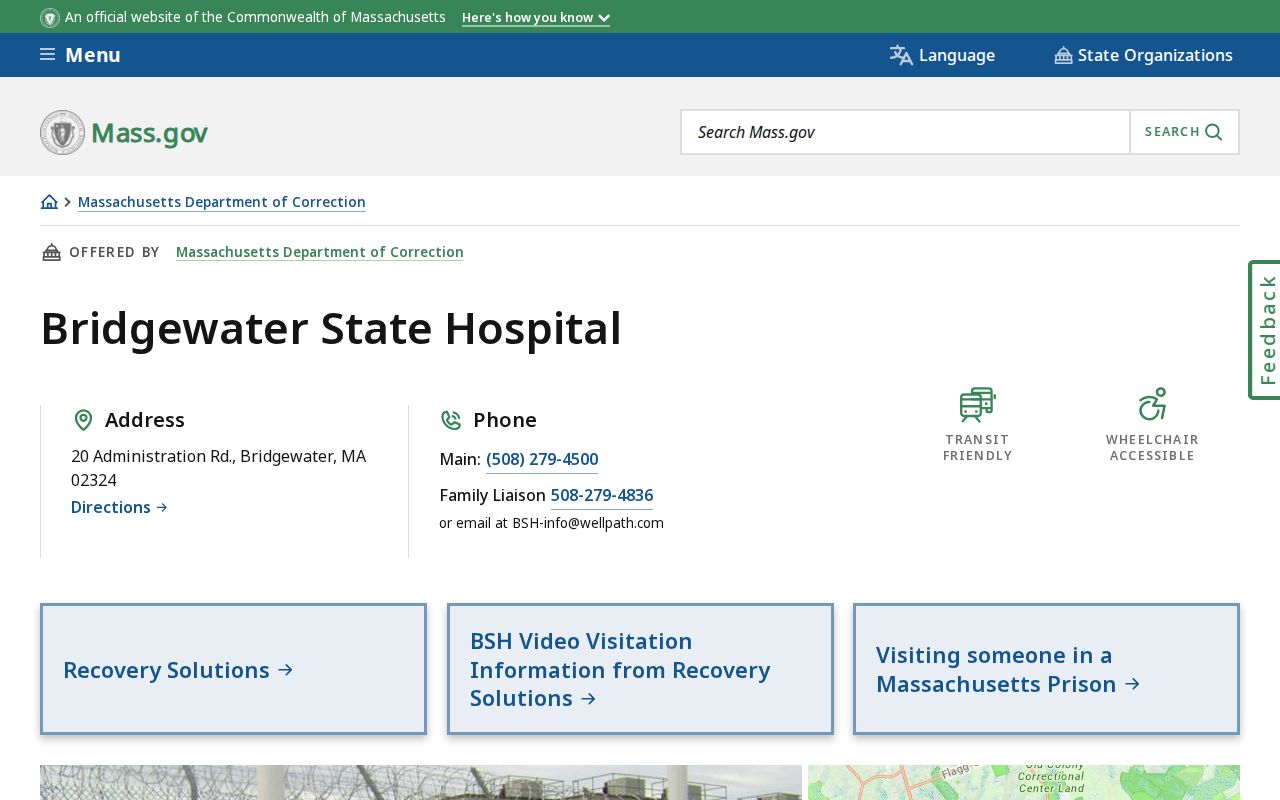
The captured page confirms the public identity and contact route. It does not confirm any named person’s placement, departure, clinical status, or criminal-case outcome.
Bridgewater Discharge Versus Release
A hospital placement can end even when another legal process continues. For a pretrial detainee, return to the original jail after an evaluation is movement between custodians. Return to court can precede a new detention, bail, recognizance, dismissal, or another order. Only the next record shows which path followed.
Civil patients should not be labeled as prisoners merely because the facility is secure or appears in the DOC location family. Their legal status comes from civil commitment. Likewise, a pretrial detainee has not been convicted merely because a court ordered evaluation. Clear terms protect both accuracy and dignity.
A released or discharged status in any single source must be bounded by the agency that reported it. “Discharged from BSH” means the hospital placement ended. It does not by itself state whether the person entered the community, another hospital, a jail, or a court setting. Record the destination and controlling order whenever public material provides them.
Bridgewater Discharge History Context
The Bridgewater and Plymouth area contains an unusual mix of institutions. Old Colony is a state prison. Massachusetts Treatment Center combines criminally sentenced and civilly committed populations under separate legal authorities. Plymouth Substance Abuse Center serves sentenced men and Section 35 civil patients. PCCF is the county jail and also holds some people for other authorities. Facility proximity does not merge their records.
MA DOC’s 2024 decision to end housing operations at the separate OCCC-Minimum modular unit is a useful local warning. Its residents were transferred to other minimum-security locations, while the medium-security Old Colony institution stayed open. That action was not a community release. It did not change Bridgewater State Hospital operations or establish a discharge for any hospital patient.
The lesson applies at BSH without importing prison language. A person can disappear from one placement because the legal authority moved them elsewhere. Confirm the ordering court, destination, and responsible agency before describing the event. The hospital’s mission and the person’s legal status remain the center of the inquiry.
That review may require more than one docket entry. The placement order explains why the person went to BSH, while a later court event may direct a return, continued commitment, or another placement. If the public docket is incomplete, ask the clerk for the public file and identify the exact order sought. Medical details can remain private even when a court event is public.
Public Record Search
Sponsored Results