
Plymouth Parole and Probation Compared
Parole and probation can both place a person under rules in the community, but they start in different ways. The Massachusetts Parole Board supervises a person released on a parole permit from a state prison or house of correction. The person remains under Board jurisdiction until the sentence reaches its lawful end or the Board grants early termination. Probation comes from the sentencing court. The Massachusetts Probation Service works through that court’s probation department.
A Plymouth County probation order may follow time served, a suspended sentence, or no custodial term. It therefore cannot prove the hour someone left Plymouth County Correctional Facility. Parole is stronger evidence that a state or county sentence continued after release, but a favorable parole decision may carry prerequisites and does not always equal the gate date.
| Point | Parole | Probation |
|---|---|---|
| How it begins | Release on a Parole Board permit | Order of the sentencing court |
| Who supervises | Parole Board Field Services | Probation department for the court |
| Best public starting record | Board decision, DOC status, or parole-record request | Criminal docket and sentence entries |
| What it does not prove | The exact physical release time by itself | That the person was ever held at PCCF |
| How it ends | Sentence expiration or Board termination | Court-ordered completion or termination |
The legal label matters. Calling probation “parole” sends a request to the wrong office. Calling parole a full discharge may also hide the fact that the sentence remains active.
- Parole
- Conditional release from custody while a sentence remains under Parole Board authority.
- Probation
- Court-ordered community supervision that may follow custody or may be imposed without it.
- Discharge
- The legal end of the sentence or custody obligation, distinct from release on parole.
- Detainer
- A request or hold from another authority that may prevent a planned community release.
Verify Plymouth Post-Release Supervision
Massachusetts has no public, name-searchable statewide parolee or probationer locator. Verification requires a chain of records. Start with the custody system, then read the decision that created supervision. For a state sentence, the official MA DOC locator instructions lead to VINELink. Only MA DOC participates in Massachusetts VINE, so this step does not search PCCF. For probation, use the court docket rather than VINELink.
- Identify whether the person was held by PCCF, MA DOC, a federal agency, or another custodian. A building departure can be a transfer.
- Check MA DOC/VINELink for current state custody, using the full first and last name or commitment number. Preserve the exact status and date labels.
- For a life sentence, search the public life-sentence decisions. Read the outcome, prerequisites, and decision date.
- Read the criminal docket for the sentence, probation order, later warrant, or termination event. Remote criminal searches usually require the docket number.
- Contact the correct Parole Board or court probation office, then use its records process for information that may lawfully be released.
A Board vote, court order, and custody transaction may carry three different dates. Keep all three. A granted parole date can change before release, while a probation entry can start after time served without stating when jail staff completed the exit process. For a broader custody-record chain, the Plymouth County released inmate search explains how to reconcile the sheriff, court, and state systems.
Note: A no-result response can reflect restricted data, spelling, a transfer, or system timing and does not establish the end of supervision.
Plymouth Parole Region 7 Records
Parole Region 7 is the practical regional contact for Plymouth County. It can route a question about the correct supervision or records channel, but it is not a public lookup desk for private check-in schedules or confidential conditions. A request for an individual parole record may require the person’s authorization. Public requests, personal-record requests, and attorney or client requests follow different rules.
Massachusetts Parole Board, Region 7231 Main Street, 2nd Floor
Brockton, MA 02301
508-587-0987
The Board’s central office handles additional records and hearing routes. Its Parole Records and Hearings page separates public records from personal or authorized files. The central office is at 12 Mercer Road, Natick, MA 01760, with 508-650-4500 and 866-480-6272. Its posted office hours are generally weekdays from 8:45 a.m. to 5 p.m.
The Commonwealth’s Parole Board location directory shows the regional supervision and reentry-office network used to route local questions.
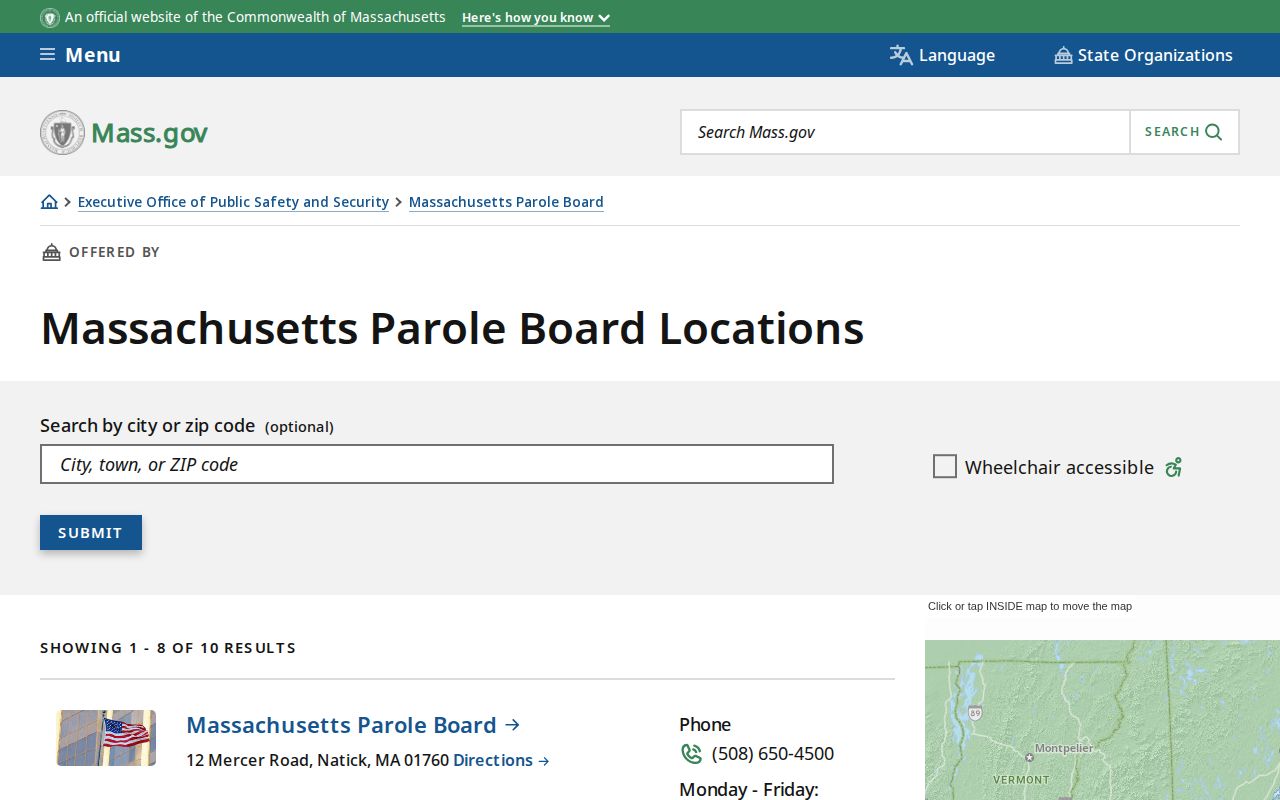
Use the directory to confirm the current office, then use the Board’s records channel for any individual file that may lawfully be released.
Probation is more local. Contact the probation department attached to the court that imposed the sentence. Plymouth County criminal cases can be routed through District Courts in Brockton, Hingham, Plymouth, or Wareham, or through Superior Court sessions in Plymouth and Brockton. The docket and municipality usually identify the right office.
Plymouth Supervision Warrants and Violations
A violation allegation does not describe one fixed status. The Parole Board can hold a revocation hearing for a person already released on a parole permit. A rescission hearing is different. It can reconsider a grant before the planned release occurs. Court probation violations proceed through the sentencing court, and the docket may show a notice, hearing, finding, or warrant.
The Board has a Warrant Apprehension Unit, but the official research sweep found no public Plymouth County parole-absconder name list. “Absconder” means a supervised person alleged to have stopped reporting or otherwise left supervision without permission. It must not be inferred from an old record, an unreachable person, or a portal that stopped updating. A warrant is confirmed through the responsible court or supervising authority.
Conditions vary by case. They can address reporting, travel, programs, or other conduct set by the court or Board. Public summaries should stay at that level. Exact reporting sites, schedules, and private conditions are not appropriate substitutes for an agency record. VINELink may report a state custody change, but it does not act as a parole warrant list.
How Plymouth Supervision Ends
Parole normally ends when the sentence expires or reaches an applicable termination point. Massachusetts also permits early termination through a separate Board process under M.G.L. c.127, §130A and the Board’s rules. Meeting the threshold to seek termination does not end supervision automatically. The Board may deny the request, schedule a public termination hearing, or terminate in a case where its rules permit action without a hearing.
Probation ends through the sentencing court’s process. The public docket may show completion, termination, a violation, or another order. If the online record is unclear, request the public case record from the clerk. Most criminal cases cannot be searched remotely by a broad name query, so a docket number or a courthouse public terminal may be needed.
A final record should distinguish release from custody, the start of supervision, and discharge from the sentence. Those events often occur on different dates. The Parole Board record is the sound source for parole termination, while the court record controls probation disposition.
Plymouth Release Reentry Planning
PCCF’s local reentry work starts before a person reaches parole or probation in the community. The Plymouth County Sheriff’s Department programs page describes a team with a manager, three advocates, and a community outreach specialist who works in PCCF and Brockton. Exit planning begins 60 days before release. It may address identification, food access, medical or behavioral-health care, treatment referrals, and transportation.
That support is not proof of supervision. A person may use reentry services and leave without parole, while another may report to Region 7 under a Board permit. Still, the exit plan can help identify the expected handoff. If the plan names a parole office, court probation department, or another authority, confirm that handoff with the named agency and the governing record.
Transportation also needs an individual plan. No official source says a public bus stops at the PCCF Release Lobby. Arrange a pickup or ask the reentry team about the person’s documented route instead of assuming a direct transit connection.
Plymouth Release Medication Handoff
PCCF publishes a specific health-care handoff that matters when supervision begins. The inmate wellness information says prescribed medication may be provided as a 30-day supply. MassHealth applications may also be sent before release. These services support continuity, but they do not establish parole or probation status.
A direct court release can bypass the ordinary facility gate sequence. In that situation, the former detainee may need to return for a prescribed-medication blister pack or contact Medical so it can be held for a short period. The court docket can prove the legal release event, while the facility’s medical handoff follows a different operational record.
Keep the two tracks separate. Questions about a medication pack go to PCCF Medical. Questions about parole reporting go to the Parole Board, and questions about probation go to the sentencing court.
Plymouth Parole Hearing Records
Life-sentence parole records have a more visible public path than most individual supervision files. The Board publishes a monthly Life Sentence Hearing Calendar and a collection of written records of decision. A decision can identify the hearing and decision dates, Board members, vote, procedural history, reasons, and any stated conditions.
Read the outcome precisely. A decision may grant or deny parole, grant it with prerequisites, set a new date, modify conditions, or leave an earlier date in place. Institutional hearings for other cases are closed, so the absence of a public decision does not show that no hearing or supervision exists.
A grant is Board action, not automatic proof of community release on the decision date. The next step may involve placement approval, another sentence, interstate compact processing, immigration custody, or another facility. Confirm the physical event with MA DOC or PCCF and keep the Board decision as the supervision record.
Public Record Search
Sponsored Results