
Plymouth Projected and Actual Release
Massachusetts uses several date labels. A Release Date is DOC’s calculated sentence release date before future earned deductions. The Earliest Release Date can reflect parole eligibility and deductions that may still be earned. ERD Max is an earliest maximum-date release under specified deductions, excluding parole-eligibility dates. The projected discharge date is the regulatory calculation after applicable adjustments and presumptive earned time.
Those labels are not synonyms. The actual release date is the day the custodian completes the approved release, parole, court, or transfer event. A projection can change before then. A person may also leave one facility for another authority, which ends one custody placement without producing community release.
Pretrial detention follows a different track. A defendant who has not been sentenced has no sentence-expiration calculation. The next event may depend on bail, a recognizance order, dismissal, a plea, sentencing, or another court action. Use the docket and PCCF confirmation rather than applying earned-time arithmetic to a pretrial case.
Find a Plymouth Projected Release Date
First identify the legal custodian. Old Colony Correctional Center and other state prisons use the Massachusetts Department of Correction computation system. A Plymouth County house-of-correction sentence belongs with PCCF and the sentencing court. Federal and immigration cases use separate records. The same name can appear in more than one system, so match the facility, docket, and identifier.
- Read the court sentence and note the docket, minimum and maximum terms where applicable, credited confinement, and concurrent or consecutive structure.
- For a state prisoner, follow the MA DOC locator instructions to Massachusetts VINELink and search by full name or commitment number.
- Copy each displayed status and date label exactly. Do not rename parole eligibility or a maximum date as the projected discharge date.
- If the public result lacks the needed field, ask MA DOC for the sentence listing, date-computation record, release order, and certificate of discharge or release.
- For a PCCF sentence, use the court record and call 508-830-6200 for the proper confirmation or authorized records route.
- Check the Parole Board, court, BOP, or ICE record when another authority may control the next move.
MA DOC’s public locator does not promise that every live result exposes the full computation record. A recent result can still be a useful lead. If it disappears, that alone does not prove release. The Plymouth County release search explains the custody-system split and durable record routes.
The official Massachusetts release-type definitions show why community release, parole, court release, and transfer must be kept separate.
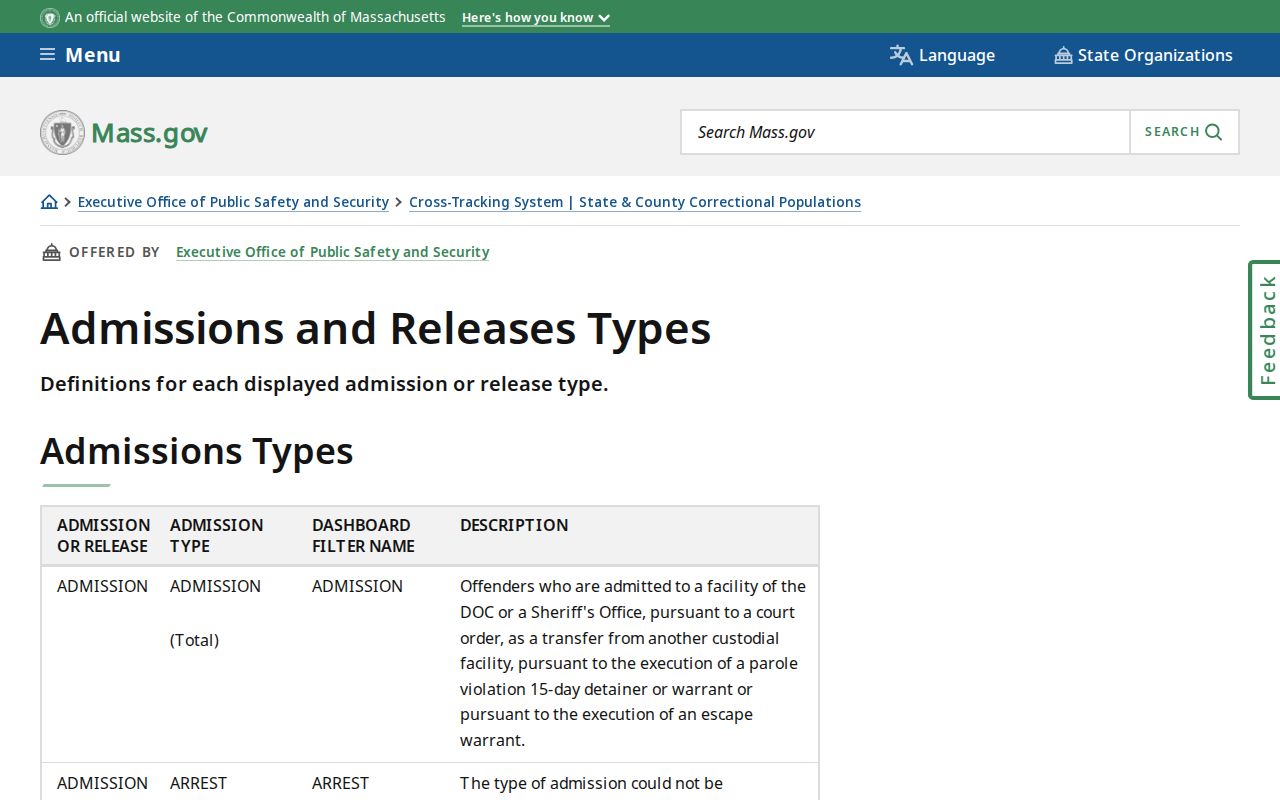
These categories help interpret the eventual actual event after a Plymouth County projected release date is calculated.
Plymouth Earned-Time Release Computation
A state computation begins with the sentence and credited confinement, then applies only deductions authorized for that person. Under 103 CMR 411, the projected discharge date uses the applicable maximum or good-conduct date, adjustments, earned deductions, and forfeitures. The regulation can treat final-month earned time as presumptive, but the credit is applied only after satisfactory participation is confirmed.
M.G.L. c.127, §129D sets detailed program, activity, and completion credits. A state-prison sentence may receive up to 7.5 days per qualifying program or activity per month, with no more than 15 days total monthly. A house-of-correction sentence may receive up to 5 days per program or activity and no more than 10 days monthly. A qualifying completion deduction of up to 10 days may also apply.
The statute allows designated completion credits for a state-prison prisoner up to 80 days, with aggregate completion credits capped at 17.5 percent of the imposed maximum. Reductions of the imposed maximum and the minimum used for parole eligibility are also subject to statutory 35 percent ceilings. These are limits, not promises that every person earns the maximum.
For PCCF, begin with the court’s sentence, confinement credit, and the custodian’s official computation. No public PCCF calculation worksheet or facility-specific weekend advance rule was found. The sheriff’s booklet describes weekday processing, not a statute that moves all weekend expirations to Friday.
Why Plymouth Release Dates Change
A projection reflects the record at one point in time. Later credit, a corrected order, program performance, or another authority’s action can change it. Even when the arithmetic is correct, the destination may change from the community to another custodian.
| Factor | Possible effect | Record to confirm |
|---|---|---|
| Pre-sentence credit | Moves the computed date when credited confinement is corrected | Court mittimus and computation record |
| Concurrent or consecutive terms | Changes how multiple sentences overlap or follow | Sentencing order and sentence listing |
| Earned or completion credit | May reduce a qualifying term within statutory limits | DOC or custodian computation |
| Forfeiture or restoration | Removes or restores credit after the required process | Official deduction record |
| Parole action | May establish, deny, rescind, or alter a parole date | Parole Board decision |
| Warrant or detainer | Can route the person to another authority instead of the community | Holding and receiving agencies |
| Corrected court order | Changes the legal sentence used in the calculation | Updated docket and mittimus |
A parole grant deserves special care. It can carry prerequisites and may lead to field supervision, interstate compact supervision, another sentence, ICE, or another facility. The decision date is not always the physical release date.
Note: A detainer can end one facility placement without releasing the person to the community, so always identify the receiving authority.
Confirm Plymouth Actual Release Dates
For MA DOC, the strongest historical proof is the approved certificate of discharge or release under 103 CMR 410, paired with the sentence, court, or parole record. The regulation provides for advance review of a release order by Central Office Date Computation and final approval. That process is more durable than a locator result that may later be archived.
VINELink can add a timely alert. Register from the correct MA DOC result, choose an available delivery method, and confirm the event with the reporting institution. The Plymouth County VINELink check gives the exact search and PIN steps. It also explains why Massachusetts VINE cannot confirm a PCCF-only case.
For PCCF, reconcile the court order with the sheriff’s custody transaction. PCSD says identifiable incarceration and release data is CORI unavailable through the ordinary public-record process, so do not promise that a general request will produce another person’s release sheet. An authorized requester may have a different path. Ask for the public or segregable portion and a written exemption citation where appropriate.
Plymouth Release Date 85 Percent Myth
Massachusetts does not use a safe, universal “serve 85 percent” formula. The 1994 truth-in-sentencing changes eliminated the former statutory good-time scheme for offenses committed after June 30, 1994. Current law still provides program and activity deductions and completion credits under §129D, with monthly, aggregate, and percentage limits.
The result depends on the offense date, governing statute, sentence type, program participation, court-imposed minimum and maximum, and any mandatory-minimum restriction. Life sentences have separate eligibility rules. A hand calculation that applies one percentage to every Plymouth County sentence can be materially wrong.
Use the MA DOC glossary to preserve the agency’s date terms, then request the official computation when the public result is incomplete. “Earliest” does not mean guaranteed, and a projected date does not override a later lawful hold.
Plymouth Weekday Release Processing
The PCCF visitor booklet says sentenced and parole releases commence after 9 a.m. Monday through Friday. That statement describes when routine processing begins. It does not promise that every person exits at 9 a.m., and it is not a rule that shifts every weekend sentence date.
Bail follows a different process tied to a bail commissioner’s availability. A pretrial defendant therefore should not be assigned a projected sentence-release date. Check the docket for the court action, call PCCF for the current process, and allow for any other warrant or agency hold.
The actual custody record remains controlling. A pickup plan should be based on direct facility confirmation, not a hand-counted date or a general weekday statement.
Plymouth State and County Release Dates
A state-prison date and a house-of-correction date may draw on the same statute but belong to different custodians. MA DOC calculates state sentences and maintains the certificate process. PCCF administers the local sentence under the court’s order. DOC’s records office expressly says it does not handle county-jail or house-of-correction requests, so sending a PCCF question to Milford creates delay rather than proof.
For a state sentence, request the sentence listing, date-computation entries, approved release order, certificate of discharge or release, release institution, and release type. Those records can distinguish parole, discharge, transfer, court release, or another authority’s custody. For a PCCF sentence, identify the committing court, docket, booking period, and the specific release or computation record sought. PCSD’s CORI limits may restrict disclosure to an ordinary requester.
The court’s mittimus is central in both systems. A mittimus is the court document that commits a person to custody and states the sentence. If an amended order changes confinement credit or the relationship among sentences, the custodian must compute from the corrected legal record. The docket can show that amendment even before a public locator reflects it.
Some Plymouth County facilities require extra care. Massachusetts Treatment Center can involve an independent civil commitment after a criminal sentence. Bridgewater State Hospital may hold a civil patient or a pretrial defendant for evaluation. Plymouth Substance Abuse Center includes sentenced and Section 35 populations. A criminal projected release date does not, by itself, answer when a separate civil placement ends.
Ask which legal authority controls the next move. That question prevents a prison sentence date, hospital discharge, treatment end date, and community release from being collapsed into one misleading number.
Public Record Search
Sponsored Results