
MTC Release Authority
Massachusetts Treatment Center in Bridgewater has two distinct legal populations. It houses criminally sentenced men identified as sex offenders. It also houses people civilly committed as sexually dangerous persons. The legal source of custody controls what “release” means. A person can finish a criminal sentence yet remain confined under an independent civil order. Conversely, the end of a civil commitment is not itself a criminal sentence discharge.
For a sentenced person, MA DOC sentence computation, parole action, and the certificate of discharge or release form the record chain. For a civilly committed person, the Superior Court proceeding and MTC record identify whether commitment continued, changed, or ended. The public Sex Offender Registry Board system is only a narrow post-release source for qualifying, finally classified people in the community. It neither supplies the exact gate date nor covers every person.
| Legal population | Controlling release source | What not to assume |
|---|---|---|
| Criminal sentence | MA DOC, court sentence, and Parole Board if applicable | Leaving MTC may be a transfer within DOC |
| Civil commitment | Superior Court commitment case and treatment-center record | Sentence completion does not end the civil order |
| Community registrant | SORB public or named-person request within its legal limits | A registry entry is not a release-date record |
MTC Criminal Release Search
Massachusetts VINE is the official public custody-search route named by MA DOC. The Commonwealth says only MA DOC participates in Massachusetts VINE. Search by full first and last name or commitment number. A result may show custody status, reporting agency, location, identification number, and date information supplied by DOC. Copy the displayed labels exactly.
- Open the MA DOC “Find someone housed” instruction and follow its Massachusetts VINELink link.
- Search the Massachusetts Department of Correction using the full legal name or commitment number.
- Review the result for the precise custody status, facility, reporting agency, and date label.
- Compare any parole information with the DOC record. A grant can carry prerequisites and is not always the physical release date.
- For durable proof, request the certificate of discharge/release and public sentence-computation record from MA DOC.
A missing result is not historical proof. Records may be archived, names can mismatch, and a person may have moved to another institution or authority. “Projected discharge,” “maximum date,” “parole eligibility,” and “actual release” are different. Use the Plymouth County release search to route court, state, federal, and county checks when the custody history spans systems.
MTC Civil Commitment Release
Civil commitment at MTC arises under a legal authority separate from a prison sentence. The relevant Superior Court case is therefore central. A criminal docket may show a conviction and sentence, while the civil proceeding addresses commitment as a sexually dangerous person. Read both when both exist. Do not convert the end of the sentence into a claim that the civil placement ended.
MassCourts remote criminal access generally requires a docket number. A courthouse terminal can offer broader name-based access where court rules permit, and official copies come from the clerk. Civil commitment material may have access limits, impoundment, or restricted health information. Ask the correct Superior Court clerk for the public docket and orders rather than seeking medical detail from a general locator.
The court order and responsible agency record should show the legal basis for continued placement, transfer, conditional status, or discharge. Medical privacy can restrict what relatives or other members of the public receive without authorization. That limit is not evidence that a discharge did or did not occur.
Note: A court’s public legal disposition and confidential treatment details are different records with different access rules.
MTC Release Record Requests
For the criminal sentence, a targeted MA DOC request can seek the certificate of discharge or release, actual custody-release date, release type, release institution, and public portions of the release order and date-computation record. Under 103 CMR 410, the department reviews the sentence and earned time before final approval. That certificate is stronger historical evidence than a locator screen.
MA DOC accepts requests by online form, email, mail, and telephone at the Records Access Officer’s discretion. The office is at 50 Maple Street in Milford. The department’s page also warns that it does not process county jail requests. MTC is a state location, so this state route is correct for its criminal sentence records.
MA DOC Records Access OfficerKate Silvia
50 Maple Street
Milford, MA 01757
508-422-3436
doc.rao@state.ma.us
Massachusetts law generally requires a written response within ten business days. Exemptions may protect medical information, privacy, security material, sealed or expunged records, and other restricted data. Ask for reasonably segregable public portions. For civil commitment, direct the request to the court or responsible record holder for that proceeding rather than asking DOC to create a combined explanation.
MTC Release Contact
The institution’s official location page confirms the current address and main number. Staff can route facility questions, but a general call does not replace the court order, DOC sentence file, or authorized civil record. Give only the identifiers needed to locate the correct person and record.
Massachusetts Treatment Center30 Administration Road
Bridgewater, MA 02324
Main: 508-279-8100
Agency: Massachusetts Department of Correction
The official Massachusetts Treatment Center page is the successful manifest source matched to this facility.
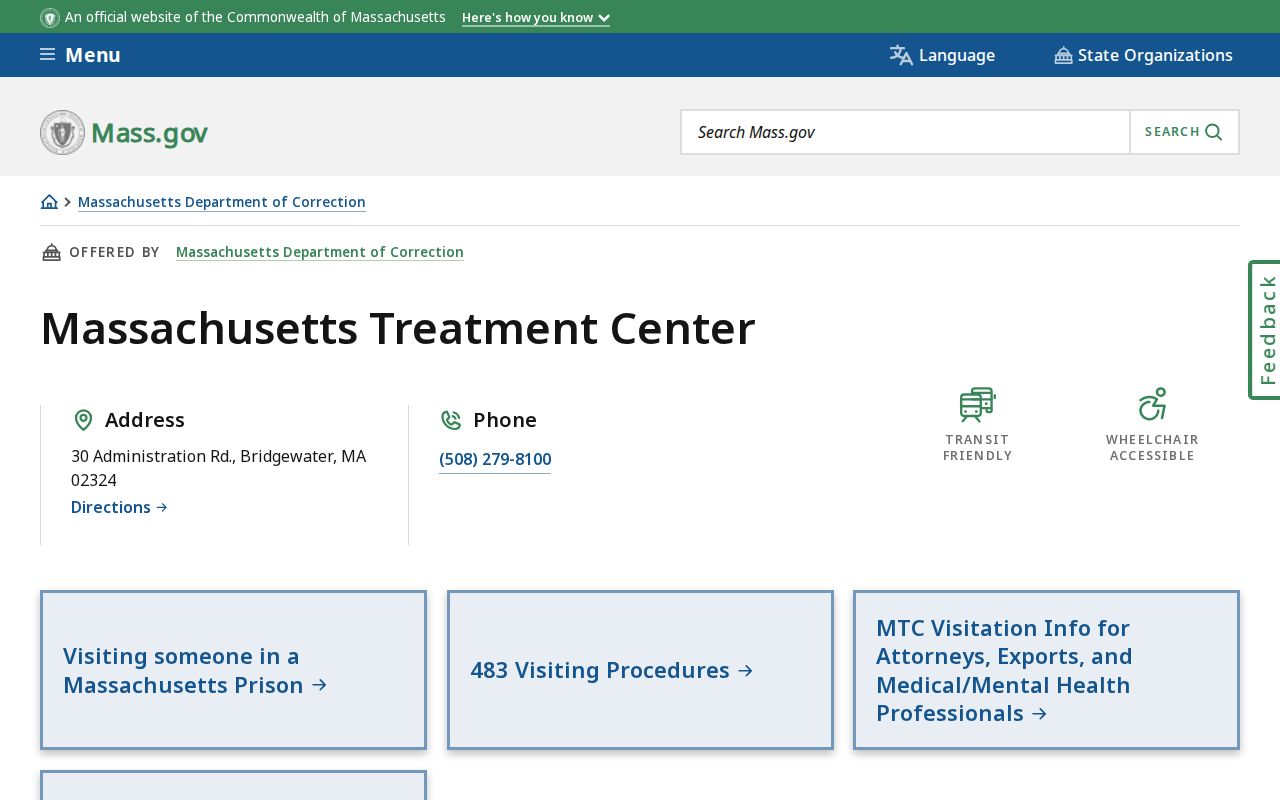
The capture identifies MTC as the subject and supplies its public contact route. It cannot establish whether a particular criminal sentence or civil commitment ended.
MTC Post-Release Registry Check
SORB can provide a narrow community-status trace after an MTC departure when the person has a qualifying registration duty and a public classification. Online access covers Level 3 registrants and Level 2 registrants classified after July 12, 2013. Level 1 information is not public. Some complete Level 2 information requires a local-police or named-person SORI request.
Search options include the public ESORI system, an in-person request at the appropriate police department, and the SORB inquiry form. A public result can reflect residence, work, or school information for a qualifying registrant. It does not state the MTC release time, and it does not resolve whether the person completed a criminal sentence before or after civil commitment.
- Sentence discharge
- The formal end of the criminal sentence authority.
- Civil commitment
- Court-ordered placement under civil law, separate from a criminal sentence.
- Parole
- Release from prison while the criminal sentence remains under supervision.
- Registry
- A limited post-release system based on classification and registration law, not a general release list.
An absent SORB result is inconclusive. It may reflect classification rules, a pending or nonpublic level, no duty, or data limits. Never use absence to declare that the person is still confined or has been released.
MTC Release History Context
MTC sits within a Plymouth County cluster of institutions that serve very different legal roles. Old Colony is a state prison. Bridgewater State Hospital is a forensic hospital. Plymouth Substance Abuse Center includes sentenced and Section 35 populations. PCCF serves county and other custodial populations. The correct inquiry is not merely where the person was housed, but which legal authority controlled the departure.
The 2024 closure of the separate OCCC-Minimum housing unit illustrates that point. MA DOC transferred that unit’s population while the medium-security Old Colony institution remained open. It was not a community release and did not change MTC’s operations or the status of anyone at MTC. A facility or unit closure cannot be used to infer the outcome of a separate criminal sentence or civil commitment.
At MTC, the risk of a wrong inference is especially high because two authorities may overlap. Trace the criminal sentence with DOC and parole records. Trace civil commitment through the court and responsible facility record. Only then can “released” be used with enough precision to explain which custody ended and what legal status followed.
A public SORB result may add limited evidence that a qualifying, finally classified registrant is in the community, but it cannot replace either chain. The registry does not supply MTC’s gate time or prove when a criminal sentence ended. A result must be read only for the registration facts it actually displays, while the criminal and civil records remain the controlling sources.
Public Record Search
Sponsored Results