
Plymouth VINELink Coverage Boundaries
VINELink is the public interface for custody information supplied by participating agencies. The Commonwealth’s official prison-locator instructions state that only the Massachusetts Department of Correction participates in Massachusetts VINE. That means a record from Old Colony Correctional Center or another MA DOC institution may appear. A person held only at Plymouth County Correctional Facility is outside this state VINE feed.
This is not a small technical distinction. PCCF houses county, state, federal, and ICE-related populations. A person can leave one authority yet remain in another authority’s custody. VINELink reports what MA DOC supplied. It does not search the Plymouth County Sheriff’s Department, BOP, U.S. Marshals Service, or ICE.
A recently released MA DOC record may remain visible with a reported custody status and date information. The interface does not promise permanent historical coverage. An archived record cannot be tracked through VINE, and silence cannot be converted into a release finding.
Search a Plymouth Inmate on VINELink
Begin at the official agency instruction rather than a copied search form. The Massachusetts page links to the correct state instance of VINELink and explains the required inputs. Search one named person. Broad browsing does not resolve whether a Plymouth County case belonged to the sheriff, MA DOC, or another system.
- Open Massachusetts VINELink and confirm that Massachusetts is selected.
- Choose the Massachusetts Department of Correction reporting agency when the interface asks for an agency.
- Enter the person’s full legal first and last name. Use the DOC commitment number when known, especially for a common name.
- Compare any matches with lawful identifying details. Do not assume the first similar name is the right person.
- Open the individual result and record the exact agency, location, custody status, commitment number, and each displayed date label.
- If no result appears, check the court and the correct custodian. Request a DOC release record when durable proof is needed.
The full-name rule can create false negatives when a name changed, a middle name was entered differently, or the commitment number is wrong. Repeat only with known legal variations. Do not create a conclusion from guesswork. The Plymouth County released inmate search sets out the separate sheriff, court, DOC, BOP, and ICE routes.
The official Massachusetts search screen shows the state-specific entry point used for MA DOC records.
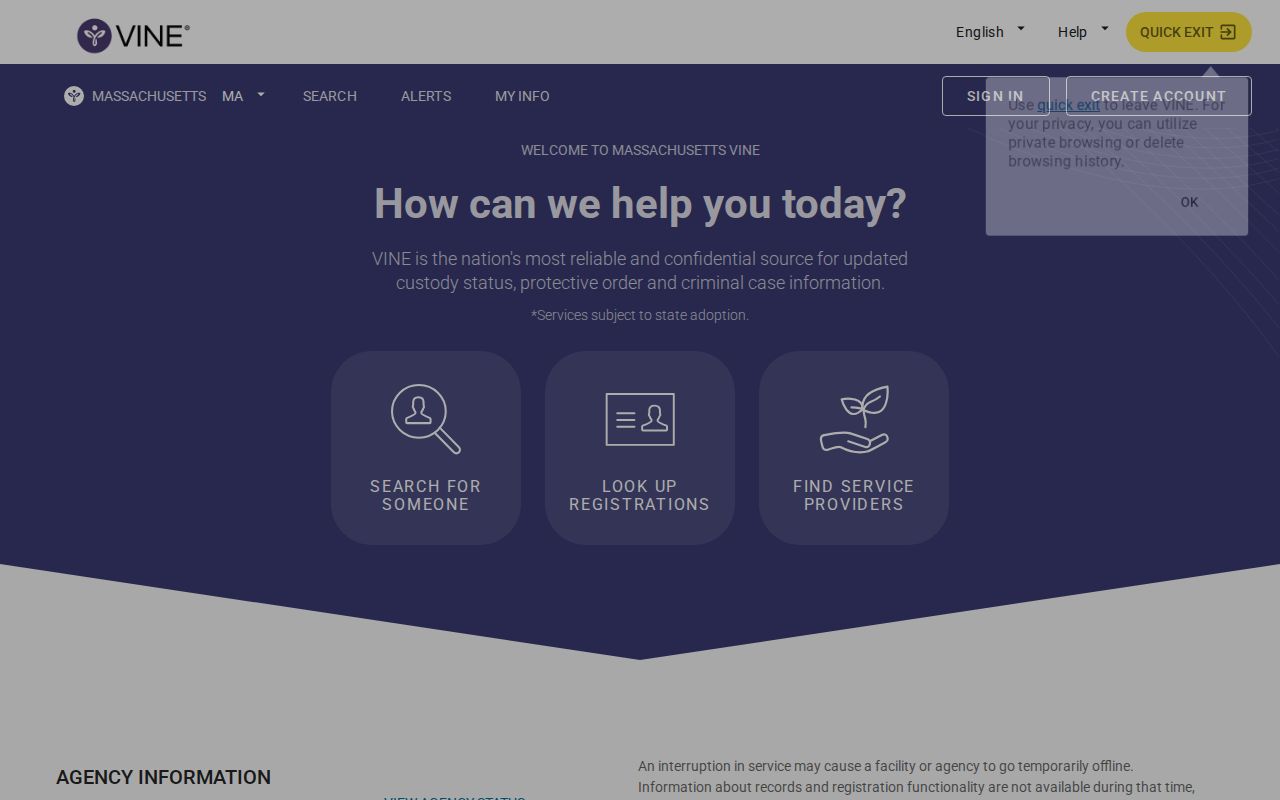
This screen is the proper starting place for a state-prison record, but it is not a Plymouth County jail roster.
Plymouth VINELink Release Fields
Public fields depend on the record MA DOC sends. A result can display identity, commitment number, custody status, reporting agency, location, and personal descriptors. It may also include date information. Copy the displayed label word for word because “release date,” “projected discharge date,” “earliest release date,” and “parole eligibility” do not mean the same thing under Massachusetts rules.
| Field | What it can establish | Limit |
|---|---|---|
| Custody status | The status most recently supplied by MA DOC | Does not rule out another authority’s custody |
| Reporting agency | Which participating agency supplied the record | Massachusetts participation is limited to MA DOC |
| Location | The last reported MA DOC institution or placement | A move can be a transfer, not release |
| Commitment number | A stable identifier for matching the right state record | It is not a PCCF booking number |
| Date label | The date category shown by the interface at that time | Future dates may change and labels must not be rewritten |
| Descriptors | Details that help distinguish similar names | Availability varies by record |
“Released” means the person left the participating MA DOC status. It does not automatically mean release to the community. A transfer to a county, federal, immigration, out-of-state, or other authority may follow. For historical state proof, ask MA DOC for the certificate of discharge or release, the actual custody-release date, release type, and public portions of the release order.
Register Plymouth VINELink Release Alerts
Notification starts from the correct individual result. Available methods and events can vary, so read the choices on that record. Use more than one delivery channel when a timely alert matters. Registration supplements direct confirmation; it does not make VINELink the legal record of release.
- Open the verified MA DOC result and select the Register or notification control.
- Choose from the offered email, SMS, phone or TTY, or in-app delivery methods.
- Enter the delivery contact and select the available language setting.
- Create the requested four-digit notification PIN and store it securely.
- For a phone alert, enter the PIN followed by the number sign to confirm receipt and stop repeat calls for that event.
- Use the same PIN when the service requires it to change notifications.
The four-digit notification PIN is not the same as a separate account-verification code. Do not put another person’s phone number or email into a test registration, and do not capture private contact details in a screenshot. The current Massachusetts locator lists 866-277-7477 for help, while an older DOC policy shows a different number. Use the current locator contact first.
Note: An alert reports a participating agency event and should be checked against the reporting facility before travel or any time-sensitive action.
Confirm Plymouth VINELink Release Status
Use the reporting agency shown on the result. If MA DOC supplied the status, request the underlying state record from the Department of Correction when a lasting document is needed. Its records office can address a certificate, release order, release type, and date-computation material, subject to exemptions. DOC expressly does not process county-jail requests.
For a PCCF case, call 508-830-6200 and check the committing-court docket. PCSD publishes no public inmate search or recent-release list, and its guidance says identifiable incarceration and release information is CORI that is not available through an ordinary public-record request. An authorized requester may have a different route. A court docket can show the bail, recognizance, dismissal, sentence, time-served, probation, or warrant event, though it may not show the physical exit time.
Federal cases require the BOP Inmate Locator for a sentenced federal prisoner or the federal docket for a pretrial defendant. ICE has its own locator with a limited recent-release window. Neither system feeds Massachusetts VINE. A record that vanishes from VINELink may be archived, transferred, mistimed, or released. Confirm the reason before recording a status.
Plymouth Release Notification Registry
Massachusetts also operates a separate Victim Notification Registry through the Department of Criminal Justice Information Services. It is an eligibility-based route for victims, witnesses, and certain family members or guardians. Registration is confidential. It is not the same service as a public VINELink registration and should not be presented as an open name search.
The official registry instructions explain who may register and how the application is handled. A person who qualifies can use that channel alongside VINE, but the two systems may have different records, event types, and contact rules. Questions about registry eligibility belong with DCJIS rather than PCCF or VINELink support.
This local layer matters because Plymouth County custody can cross systems. A county detainee is not covered merely because MA DOC uses VINELink. Match each notification request to the authority holding the person.
Archived Plymouth VINELink Records
VINELink is built for custody status and notification, not indefinite research. Once a record is archived, tracking through VINE ends. A missing old record should lead to the court, MA DOC records, or the correct federal or county agency, depending on who held the person.
For a former state prisoner, the approved certificate of discharge or release is stronger evidence than an old screen capture. The certificate process includes sentence and earned-time review. Pair that document with the court or Parole Board record when supervision or another hold may have followed.
A recently displayed result is still useful. Record the time, exact labels, and reporting agency, then verify the event. That practice preserves what the interface actually said without turning a temporary screen into a broader claim.
Plymouth Custody Systems Before VINELink
The facility name should decide whether VINELink is the right first tool. Old Colony Correctional Center and the Massachusetts Treatment Center are within the MA DOC system, though MTC can involve both criminally sentenced and civilly committed populations. Bridgewater State Hospital has a distinct forensic-hospital mission. Plymouth Substance Abuse Center can house sentenced men and civilly committed patients. The court record may be more important than a custody search for civil or evaluation placements.
| Custody setting | First check | What VINELink cannot settle |
|---|---|---|
| PCCF county case | Sheriff and committing court | County custody because PCCF does not participate |
| MA DOC state sentence | Massachusetts VINELink | Permanent discharge history after archiving |
| Federal sentence | BOP locator | Federal release or supervised-release status |
| ICE custody | ICE ODLS and agency contact | Immigration transfer, removal, or long-term history |
| Court-ordered civil placement | Ordering court and responsible facility | Whether departure ended a criminal or civil obligation |
A person leaving PCCF may move to MA DOC, BOP, ICE, another county, or the community. Search the receiving system when the docket or agency record indicates a transfer. If no source identifies the destination, ask the originating custodian for the public portion of the transfer or release authority rather than guessing.
MassCourts can show bail, recognizance, dismissal, sentence, time served, probation, warrants, and other legal events. Most criminal cases are remotely searchable only by docket number. A courthouse public terminal can help locate a case when only the name is known, subject to the court’s access rules.
Public Record Search
Sponsored Results